9-9-6: If You’re Not Working 72 Hours a Week Are You Even Trying?

Updated: Aug 17, 2025
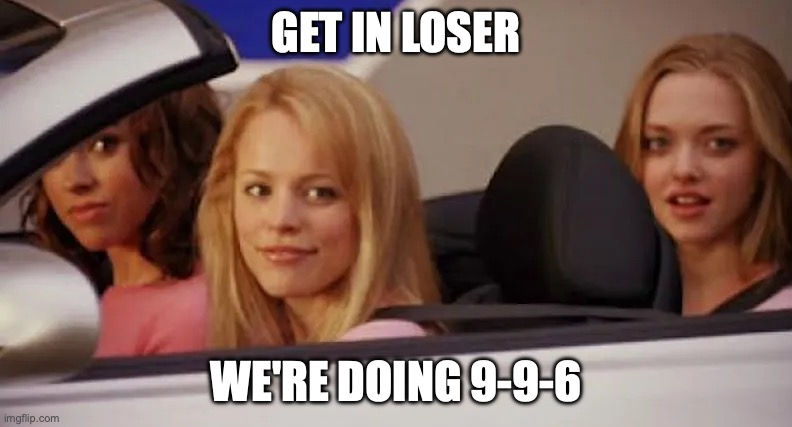
9-9-6 is here to Kick Ass
Welcome to Silicon Valley 2025. Perks are out and grind is in so get in loser or pussy out if you can’t handle the heat because we’re in it to win it and nothing, especially not work-life-balance, is going to stop us.
The new and improved age of caffeinated ambition and always-on execution is here. The 9-9-6 work culture—working 9 a.m. to 9 p.m., six days a week has swaggered into the Silicon Valley discourse, imported from the hard-scrabble tech floors of Shenzhen. This billionaire’s fever dream is no longer a peculiarity of Chinese unicorns. It’s now openly pitched in venture meetings and quietly (or loudly) being adopted in incubators across The Valley. Just ask the folks at Windsurf who recently acquired AI darling Cognition and offered staff the “exit door” should they not wish to assimilate into a more” focused" work environment.
Why is 9-9-6 Gaining Ground?:
In the new tech frontier of generative AI with the perception that worlds exist for the conquering, 9-9-6 is being positioned not as staff exploitation but as the cost of innovation. To many founders and investors, it feels not just attractive but necessary. The pace of technological change, competitive funding environments and inflated expectations of success all create a gravitational pull toward intense, round-the-clock labor.
Why would anyone want this? The psychological pull for young men:
To begin with an uncomfortable truth: 9-9-6 culture is oddly attractive to a certain kind of young man. Not because it’s healthy, fair or even productive in the long term but because it hits just the right psychological pressure points. This can be understood through the lens of identity formation and achievement motivation. Erik Erikson’s theory of psychosocial development suggests that young adulthood is a period of intense focus on identity and productivity. For young men entering competitive, high-status industries, 9-9-6 offers something potent: A clear path to status, identity, and validation. Angela Duckworth in “Grit” has shown how commitment to long-term goals can lead to outsized success and the 9-9-6 schedule offers a tangible framework for demonstrating that commitment. The structure is both a proving ground and a badge of honor.
Author’s Note: This isn’t all academic for me. Some of my happiest memories were from months sleeping on the floor working on the first versions of Epocrates. There’s a thrill and a pride in the effort that you put in to doing something that you believe really matters and so I’m speaking from experience when I say I get it.
This isn’t just hustle culture. This is hustle as identity. 9-9-6 is not exactly new. It is the latest iteration of the “rise and grind” ethos that has pervaded startup culture since the early 2000s. Where earlier hustle culture was aspirational and self-directed, 9-9-6 is a more insidious repositioning of the goalposts – shaming individuals as inadequate if they can’t meet this externally imposed imperative.
9-9-6 is perhaps “Revenge of the Nerds,” but with venture funding and biometric sleep tracking. At last here is a performative masculinity that doesn’t require abs or aggression, just IDE commits, 16-hour days and loyalty to the mission. It's a techno-libertarian masculinity: Intense, measurable and absolutely immune to work-life balance. Mark Zuckerberg declared he wants to bring more "masculine energy" into his company culture. Meanwhile, elite AI researchers are now commanding salaries rivaling NBA playersand negotiating like them.

Interestingly, while men dominate 9-9-6 discourse, there is little evidence of women-led startups adopting the model with the same enthusiasm. This may speak to gendered understandings of leadership and sustainability. Studies show women founders are more likely to prioritize organizational health, collaboration and long-term sustainability over short-term velocity.
When 9-9-6 Works: A Case for Early-Stage Startups
To be fair, 9-9-6 can work in specific scenarios. Specifically the brutally competitive early stages of startup life where velocity issurvival and alignment matters more than almost anything else. When teams are small and goals are existential, long hours can foster cohesion, reduce communication overhead and dramatically accelerate time-to-market.
Contemplating Mihaly Csikszentmihalyi’s concept of “flow” describes a state of complete immersion and energized focus that most folks describe as feeling pleasurably “lost in the task”. In environments where teams are building something meaningful and feel empowered to do so, long hours may not feel exploitative at all. In fact, they may be experienced as energizing and purposeful.
The problem with sprints though is that by definition they’re not marathons. They can’t last forever.

Why 9-9-6 Doesn’t Work…
Superficially the logic makes sense: Work Harder = Better Results. What’s hard about that? It’s what many of us were taught as small kids as our parents sought to teach us the value of effort. The problem is that our parents didn’t really have these extremes in mind. Research shows that under scientific scrutiny overwork produces diminishing or even negative returns:
Economist John Pencavel of Stanford University analyzed munitions workers and found that output per hour declines sharply after 50 hours per week, and falls off a cliff after 55 hours. Working 70 hours produces the same output as working 55—the extra 15 hours are essentially useless.
Harvard Business Review: “The Research is Clear Long Hours Backfire.” This article compiles decades of researchshowing that cognitive performance, creativity, and decision-making all suffer under chronic overwork. Long hours also lead to increased errors, more absenteeism and higher turnover - all of which erode competitiveness.
A landmark global study from the WHO found that working more than 55 hours per week increases the risk of stroke and heart disease making it not only unproductive but life-threatening. Health consequences drive higher healthcare costs and absenteeism, both of which negatively impact business performance.
Microsoft Japan tested a 4-day workweek and saw a 40% increase in productivity, despite reduced hours. Meetings were shortened, collaboration improved, and employee satisfaction soared—undermining the myth that long hours drive results.
Deloitte’s 2021 report identifies burnout, driven by long hours and poor boundaries, as a strategic risk for companies. Burnout leads to disengagement, turnover, and reputational damage.
But by all means – don’t let the science dampen your enthusiasm.
Lack of Scalability
9-9-6 is a poor fit for organizations beyond the early startup phase in fact it is a cancerous ideology for any company hoping to scale without cannibalizing its people. As teams grow more diverse, the expectation of all-consuming work becomes exclusionary. Employees with families, health issues or simply different values will self-select out. This shrinks talent pools and introduces retention risk of the people who have invested their blood, sweat and tears in building the company to its present success.
Monoculture and Toxicity
Perhaps the greatest danger of 9-9-6 is cultural. It promotes a monoculture in which performance is measured by visibility and endurance rather than insight and impact. In these environments, thoughtful dissent is often silenced, rest is shamed, and collaboration gives way to heroics. These cultures are not only emotionally exhausting, they are innovation-stifling. Studies show that diverse teams in background, thought, and working styles outperform homogeneous ones in complex problem-solving.
Legal and Ethical Risk
In most Western countries, labor laws set clear limits on work hours, overtime, and rest periods. Companies that adopt 9-9-6 without structural changes to support compliance are gambling with liability. Even China, historically not a famous advocate of worker rights, has clamped down on the practice.
So Where Does This Leave Us?
Recognize that there is a time and place for intensity. There are moments when the mission is all-consuming, when the stakes are high, and when everyone must go all-in. But those moments should be the exception, not the baseline. Build systems that reward focus, not endurance. Hire for values and capability, not just stamina. Above all, design organizations that people can grow with and not ones they will inevitably grow out of.
Get in Touch
If you’re a startup founder or engineering leader grappling with how to build high-performing, sustainable teams, let’s talk. I specialize in helping organizations architect engineering cultures that scale without burning out.
Comments